
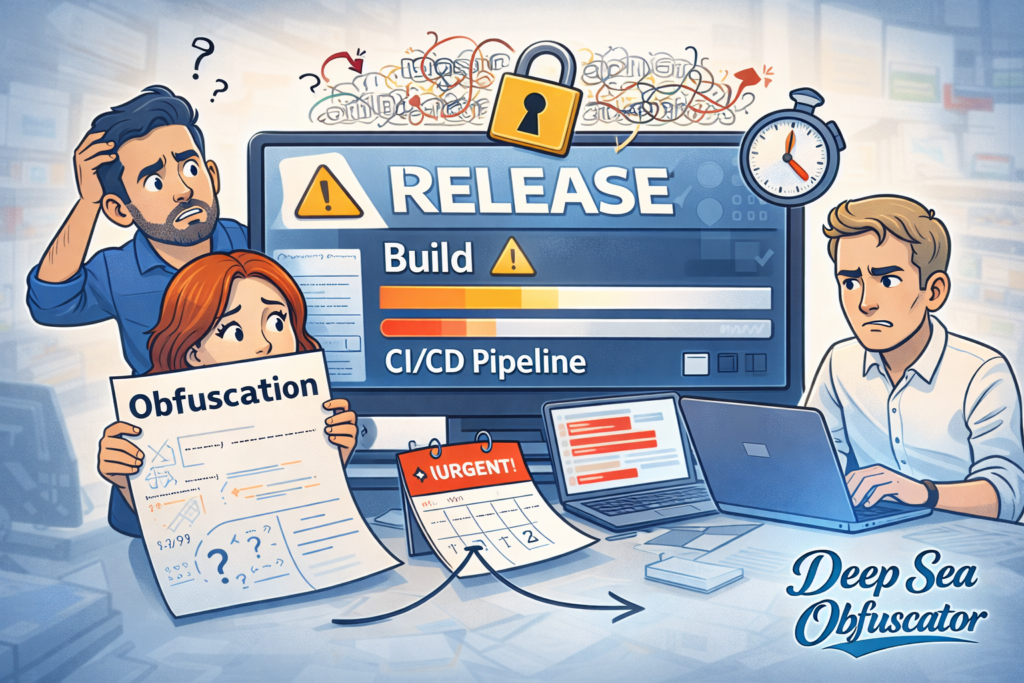
Obfuscation isn’t “a tool,” it’s a release step
Teams rarely argue about whether protection matters. The tension shows up somewhere else: the release calendar. If obfuscation slows builds, causes surprises, or becomes something only one person understands, it quietly turns into a risk. It gets postponed, reduced to a manual step, or skipped during “urgent” releases—exactly when your process needs stability the most.
In modern software delivery, anything that can’t run reliably in a pipeline isn’t a serious part of the product. That’s why the next generation of obfuscation has to be CI-first by design. The bar is no longer “works on my machine.” The bar is “runs the same way everywhere, every time, with outputs everyone can understand.”
Deep Sea Obfuscator was started to rebuild that expectation into the foundation. Not by piling on options, but by making protected builds predictable and maintainable in real teams.
The hidden cost of legacy obfuscation is uncertainty
When a legacy tool is treated like a black box, the cost isn’t just technical—it’s organizational. Settings live in undocumented corners. People remember which checkbox “fixed it last time,” but no one can explain why. A new developer joins the team and the obfuscation step becomes a scary mystery. When a runtime issue appears after release, you can’t tell whether it’s the code, the build, or the protection layer, so troubleshooting expands into days.
The most damaging part is that uncertainty teaches teams the wrong habit: avoid touching anything. That’s how fragile systems form. Obfuscation becomes frozen in time, even as the product evolves around it. Eventually, releases rely on luck and tribal knowledge—two things no company should ship with.
A CI-first approach flips that. It treats obfuscation like a normal part of engineering: versioned configuration, deterministic behavior, and reporting that tells you what changed and why. When the workflow is transparent, teams can improve it safely instead of avoiding it.
CI-first obfuscation is really about repeatability
CI-first doesn’t mean “we can run it on a server.” It means the same inputs produce the same outputs, on any machine, without hand-holding. That repeatability is what makes protected releases safe. If an obfuscation run is deterministic and its configuration is readable, you can review changes, compare results across versions, and roll forward or back with confidence. If it isn’t, every run becomes a new event—and engineering shouldn’t be event-driven.
Repeatability also changes how teams debug. Instead of asking, “Why is this broken today?” you can ask, “What changed?” That’s the moment the tool becomes manageable. Clear outputs, consistent artifacts, stable exit behavior, and meaningful logs are not “nice to have.” They are the minimum requirements for a pipeline step you want to trust.
This is one reason Deep Sea Obfuscator focuses heavily on the fundamentals. A predictable engine, configuration that belongs in source control, and reporting that can be read by humans are the core. Once those exist, features become additions instead of liabilities.
The migration challenge is real, and it must be respected
Most teams aren’t starting from scratch. They have legacy projects, old build steps, and production realities that don’t fit clean models. That’s why migration can’t be treated like a marketing sentence. It has to be a practical path that acknowledges messy configurations and “we can’t break this” constraints.
A good migration strategy makes change feel safe. It gives teams a way to adopt incrementally, compare results, and move step-by-step without betting the entire release process on one big switch. It also keeps the learning curve reasonable. If the replacement tool requires a new philosophy, new workflow, and new set of assumptions all at once, adoption fails—not because the tool is bad, but because teams have deadlines.
The goal for modern obfuscation isn’t to force ideal practices overnight. It’s to offer a stable baseline that teams can grow into. When obfuscation becomes understandable and repeatable, it stops being a fragile exception in the pipeline and becomes a dependable part of shipping.
That’s what CI-first really means: protection that works like engineering, not like superstition.