
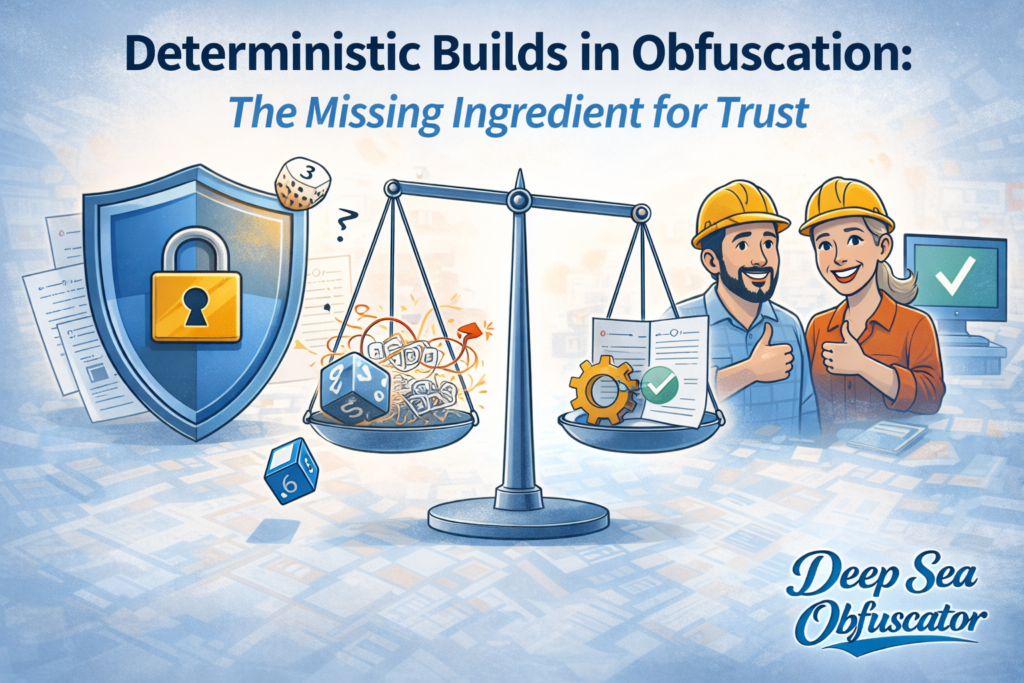
When your protection step becomes a variable, your release becomes a gamble
Most teams adopt obfuscation for one reason: reduce risk. They want to protect intellectual property, raise the bar for reverse engineering, and ship with more confidence. But many teams discover an uncomfortable truth after a few cycles: the protection step itself can become a source of uncertainty. The tool runs, artifacts appear, releases go out—yet when something breaks, it’s hard to explain what happened and even harder to reproduce it.
That’s the point where obfuscation stops feeling like an engineering practice and starts feeling like a ritual. You do it because you’re supposed to, not because you trust it. And the gap between “we run it” and “we trust it” usually comes down to one word: determinism.
Deterministic builds mean that the same inputs produce the same outputs. In other areas of software engineering, that expectation is normal. In obfuscation, it’s often missing. And in 2026, with CI/CD as the default operating mode, missing determinism is no longer a minor inconvenience—it’s a systemic risk.
Deep Sea Obfuscator exists because we believe protection should be repeatable, explainable, and testable. Determinism is the foundation that makes those values real.
Why non-deterministic obfuscation damages teams over time
Non-determinism isn’t always obvious on day one. A tool can appear “stable” for months while quietly introducing variance. A small difference in build environment, a dependency update, a different machine, or a subtle change in randomization behavior can produce different protected outputs even when the source code hasn’t changed. The result is a pattern teams learn to tolerate: “Sometimes the obfuscation output looks different. It’s probably fine.”
The problem is that “probably fine” is not an engineering standard. Over time, this uncertainty changes behavior. Teams become hesitant to touch configurations because they can’t predict outcomes. When a runtime issue appears, engineers spend hours attempting to reproduce it, unsure whether they’re dealing with a code bug, an obfuscation transformation side effect, or a mismatch between what ran locally and what ran in CI. When a release needs to be hotfixed, the protection step becomes a fear factor instead of a safeguard, and in high-pressure moments, fear tends to win.
Non-determinism also makes auditing and security reviews harder. If you can’t reliably show that a given configuration produces a consistent transformation, you can’t prove much about your process. You can only say you ran the tool. In regulated environments or security-sensitive products, that’s not enough.
Determinism doesn’t eliminate risk, but it makes risk visible. It turns obfuscation from a mysterious transform into a reproducible step with a known footprint.
What deterministic obfuscation looks like in the real world
Determinism isn’t about creating identical binaries in every imaginable scenario; it’s about controlling the variables that matter and making outcomes predictable for the same defined inputs. In practice, deterministic obfuscation means that a team can run the protection step twice and get the same protected output when the source, configuration, and tool version are unchanged. It also means that when output differs, the tool can explain why—because something meaningful changed.
This expectation shapes everything around the tool. Configuration becomes a first-class artifact that belongs in version control, because if settings can’t be reviewed and pinned, you can’t guarantee repeatability. Execution becomes pipeline-first, because CI is where teams enforce consistency across machines and time. Reporting becomes part of the product, because deterministic systems are only useful if humans can understand what happened and compare runs without guessing.
A deterministic approach also enables safe iteration. Teams can tighten protection gradually, measure impact, and roll back if needed. Without determinism, tightening protection becomes risky because you don’t know whether changes came from your settings or from the tool’s variability. With determinism, you can treat configuration adjustments like any other engineering change: review it, test it, and ship it intentionally.
Deep Sea Obfuscator’s direction is built around these realities. It’s not enough to offer “more obfuscation techniques.” The tool must behave like infrastructure: predictable, trackable, and reliable.
How to move toward determinism without freezing progress
If your current workflow includes non-deterministic behavior, the instinct is often to lock everything down and avoid change. That’s understandable, but it’s also limiting. The better approach is to make determinism a goal you move toward, step by step, while keeping releases safe.
Start by treating your protection configuration as a controlled asset. The biggest improvements often come from making settings reviewable and stable. When configuration lives in source control, it becomes easier to identify what changed, when it changed, and who changed it. That alone reduces chaos because teams stop relying on memory and “the way we did it last time.”
Next, pin the variables you can. Tool version, build environment, and dependency resolution all influence repeatability. The more you can standardize execution—especially in CI—the fewer unknowns you’re chasing later. Determinism isn’t magic; it’s the result of controlling the inputs.
Finally, demand better outputs. Even if your obfuscation tool can’t be fully deterministic today, you can still build a workflow that compares runs and captures the evidence you need. A readable summary of what happened, what was transformed, and what warnings were produced makes your process more debuggable. Over time, those artifacts become the record that lets you improve protection without fear.
The long-term win is trust. When teams trust the obfuscation step, they stop treating it like a risky ritual and start treating it like a dependable part of shipping. That trust is what allows protection to scale with the product, instead of being something the team is always afraid to touch.
Determinism isn’t just a technical preference. It’s the missing ingredient that turns obfuscation into an engineering practice you can build on.